C++之类与对象……
C++中的类
1.组成
- 类声明:以数据成员的方式描述数据部分,以成员函数(被称为方法)的方式描述公有接口
- 类方法定义:描述如何实现类成员函数
2.公有与私有
- 数据成员通常放在私有部分,组成类接口的成员函数放在共有部分
- 使用类对象的程序都可以直接访问公有部分,但只能通过公有成员函数来访问对象的私有成员
- 类声明中不加关键字默认为private
3.类的声明定义与类对象
stock00.h
1
2
3
4
5
6
7
8
9
10
11
12
13
14
15
16
17
18
19
20
21
22
23
24
25
26
using namespace std;
//类的声明
class Stock
{
private:
string company;
long shares;
double share_val;
double total_val;
void set_tot(void){total_val=shares*share_val;}//其为内联函数,函数定义在类的声明中出现
public:
void acquire(const string &co,long n,double pr);
void buy(long num,double price);
void sell(long num,double price);
void update(double price);
void show();
};stock00.cpp
1
2
3
4
5
6
7
8
9
10
11
12
13
14
15
16
17
18
19
20
21
22
23
24
25
26
27
28
29
30
31
32
33
34
35
36
37
38
39
40
41
42
43
44
45
46
47
48
49
50
51
52
53
54
55
56
57
58
59
60
61
62
63
64
65
66
67
//类的定义
void Stock::acquire(const string &co,long n,double pr)
{
company=co;//类的成员函数可以直接访问私有数据成员
if(n<0)
{
cout<<"Number of shares can not be negative!"<<endl;
cout<<"So set "<<company<<" shares =0"<<endl;
shares=0;
}
else
{
shares=n;
}
share_val=pr;
set_tot();
}
void Stock::buy(long num,double price)
{
if(num<0)
{
cout<<"Number of shares you buy can not be negative!"<<endl;
}
else
{
shares+=num;
share_val=price;
set_tot();
}
}
void Stock::sell(long num,double price)
{
if(num<0)
{
cout<<"Number of shares you sell can not be negative!"<<endl;
}
else if(num>shares)
{
cout<<"You can not sell more than you have!"<<endl;
}
{
shares-=num;
share_val=price;
set_tot();
}
}
void Stock::update(double price)
{
share_val=price;
set_tot();
}
void Stock::show()
{
cout<<"Company:"<<company<<endl;
cout<<"Shares:"<<shares<<endl;
cout<<"Share Price:"<<share_val<<endl;
cout<<"Total Worth:"<<total_val<<endl;
cout<<"---------------------------"<<endl;
}main.cpp
1
2
3
4
5
6
7
8
9
10
11
12
13
14
15
16
17
18
19
20
21
22
23
24
25
26
using namespace std;
int main(void)
{
//定义一个类的对象
Stock sto;
sto.acquire("NanoSmart",20,12.5);
sto.show();
sto.buy(15,17.125);
sto.show();
sto.sell(400,20);
sto.show();
sto.buy(3000,40.125);
sto.show();
sto.sell(1000,100);
sto.show();
return 0;
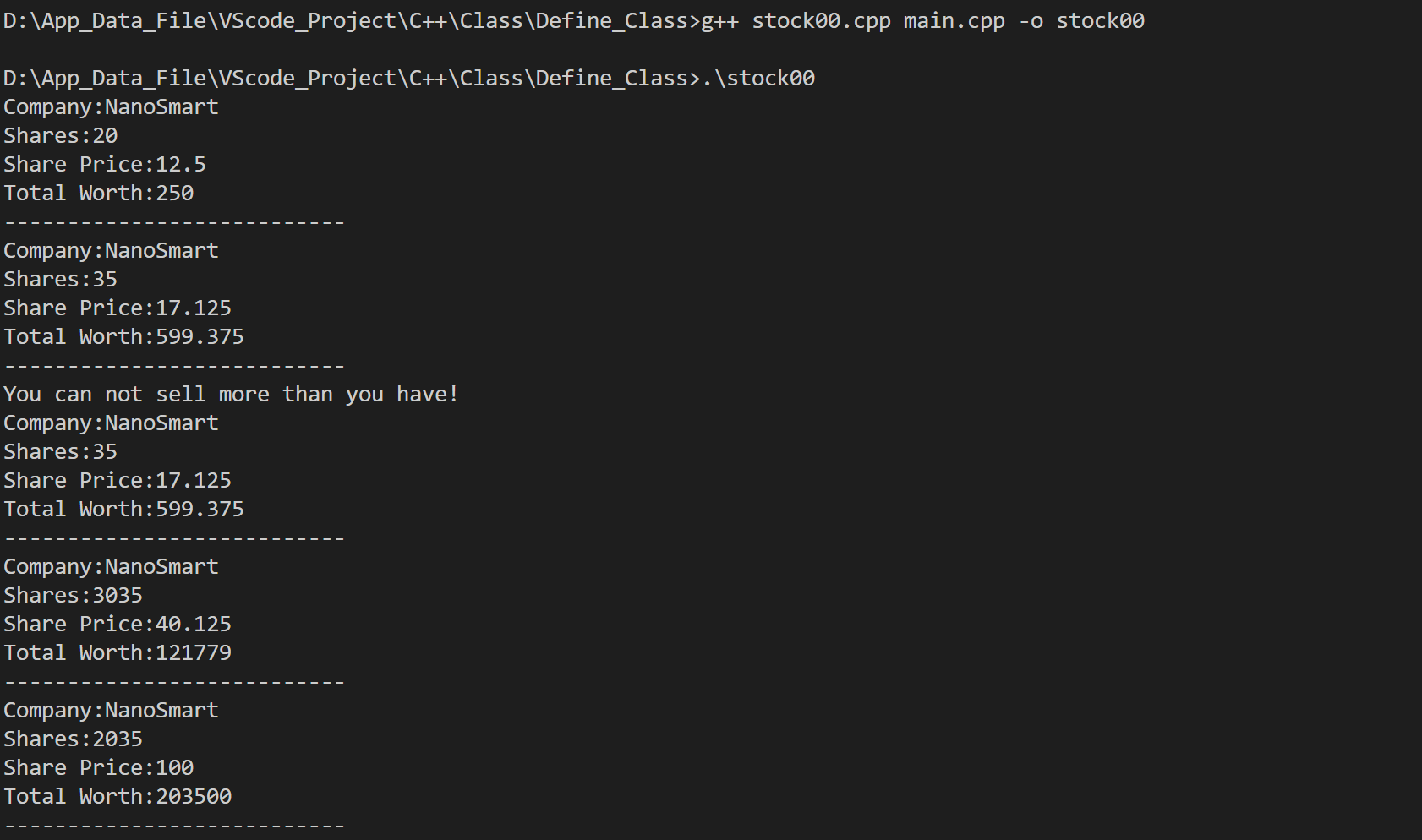
}结果如下:
4.类的构造函数与析构函数
4.1 构造函数
类构造函数就是用来初始化的
构造函数的名称与类名一样,构造函数没有返回值
用户自定义构造函数的调用:
1
2public:
Stock(const string &co,long n,double pr);1
2
3
4
5
6
7
8
9
10
11
12
13
14
15
16
17
18Stock::Stock(const string &co,long n,double pr)
{
company=co;//类的成员函数可以直接访问私有数据成员
if(n<0)
{
cout<<"Number of shares can not be negative!"<<endl;
cout<<"So set "<<company<<" shares =0"<<endl;
shares=0;
}
else
{
shares=n;
}
share_val=pr;
set_tot();
}- 显示调用:
Stock garment = Stock("Furry", 50 ,2.5); - 隐式调用:
Stock garment ("Furry", 50 ,2.5);
- 显示调用:
默认构造函数的两种定义方式:
给构造函数的所有参数提供默认值:
1
2
3public:
//默认构造函数定义方法1
Stock(const string &co="Error",long n=0,double pr=0.0);1
2
3
4
5
6
7
8
9
10
11
12
13
14
15
16
17
18Stock::Stock(const string &co,long n,double pr)
{
company=co;//类的成员函数可以直接访问私有数据成员
if(n<0)
{
cout<<"Number of shares can not be negative!"<<endl;
cout<<"So set "<<company<<" shares =0"<<endl;
shares=0;
}
else
{
shares=n;
}
share_val=pr;
set_tot();
}没有参数的构造函数:
1
2
3public:
//默认构造函数定义方法2
Stock();1
2
3
4
5
6
7Stock::Stock()
{
company="Error";
shares=0;
share_val=0;
total_val=0;
}
默认构造函数的两种调用方式:
- 隐式调用:
Stock garment; - 显示调用:
stock garment=stock();
- 隐式调用:
4.2 析构函数
析构函数完成清理工作,例:如果构造函数使用new来分配内存,则析构函数将使用delete来释放这些内存
析构函数的名称是在类名前加上
~,析构函数没有返回值和声明类型,例:~Stock()当对象被删除时,程序将调用析构函数,每个类只能由一个析构函数
stock00.h
1
2
3
4
5
6
7
8
9
10
11
12
13
14
15
16
17
18
19
20
21
22
23
24
25
26
27
28
29
30
31
32
using namespace std;
//类的声明
class Stock
{
private:
string company;
long shares;
double share_val;
double total_val;
void set_tot(void){total_val=shares*share_val;}//其为内联函数,函数定义在类的声明中出现
public:
//默认构造函数定义方法1
//Stock(const string &co="Error",long n=0,double pr=0.0);
//默认构造函数定义方法2
Stock();
Stock(const string &co,long n,double pr);
//析构函数
~Stock();
void buy(long num,double price);
void sell(long num,double price);
void update(double price);
void show();
};stock00.cpp
1
2
3
4
5
6
7
8
9
10
11
12
13
14
15
16
17
18
19
20
21
22
23
24
25
26
27
28
29
30
31
32
33
34
35
36
37
38
39
40
41
42
43
44
45
46
47
48
49
50
51
52
53
54
55
56
57
58
59
60
61
62
63
64
65
66
67
68
69
70
71
72
73
74
75
76
77
78
79
80
//类的定义
Stock::Stock()
{
company="Error";
shares=0;
share_val=0;
total_val=0;
}
Stock::Stock(const string &co,long n,double pr)
{
    company=co;//类的成员函数可以直接访问私有数据成员
    if(n<0)
    {
        cout<<"Number of shares can not be negative!"<<endl;
        cout<<"So set "<<company<<" shares =0"<<endl;
        shares=0;
    }
    else
    {
        shares=n;
    }

    share_val=pr;

    set_tot();
}
Stock::~Stock()
{
cout<<"Bye "<<company<<endl;
}
void Stock::buy(long num,double price)
{
if(num<0)
{
cout<<"Number of shares you buy can not be negative!"<<endl;
}
else
{
shares+=num;
share_val=price;
set_tot();
}
}
void Stock::sell(long num,double price)
{
if(num<=0)
{
cout<<"Number of shares you sell can not be negative!"<<endl;
}
else if(num>shares)
{
cout<<"You can not sell more than you have!"<<endl;
}
else
{
shares-=num;
share_val=price;
set_tot();
}
}
void Stock::update(double price)
{
share_val=price;
set_tot();
}
void Stock::show()
{
cout<<"Company:"<<company<<endl;
cout<<"Shares:"<<shares<<endl;
cout<<"Share Price:"<<share_val<<endl;
cout<<"Total Worth:"<<total_val<<endl;
cout<<"---------------------------"<<endl;
}main.cpp
1
2
3
4
5
6
7
8
9
10
11
12
13
14
15
16
17
18
19
20
21
using namespace std;
int main(void)
{
Stock garment;
garment.show();
Stock sto("NanoSmart",20,12.5);
sto.show();
Stock sto2("Fultty",50,20.7);
sto2.show();
//类对象之间可以直接赋值
sto=sto2;
sto.show();
sto2.show();
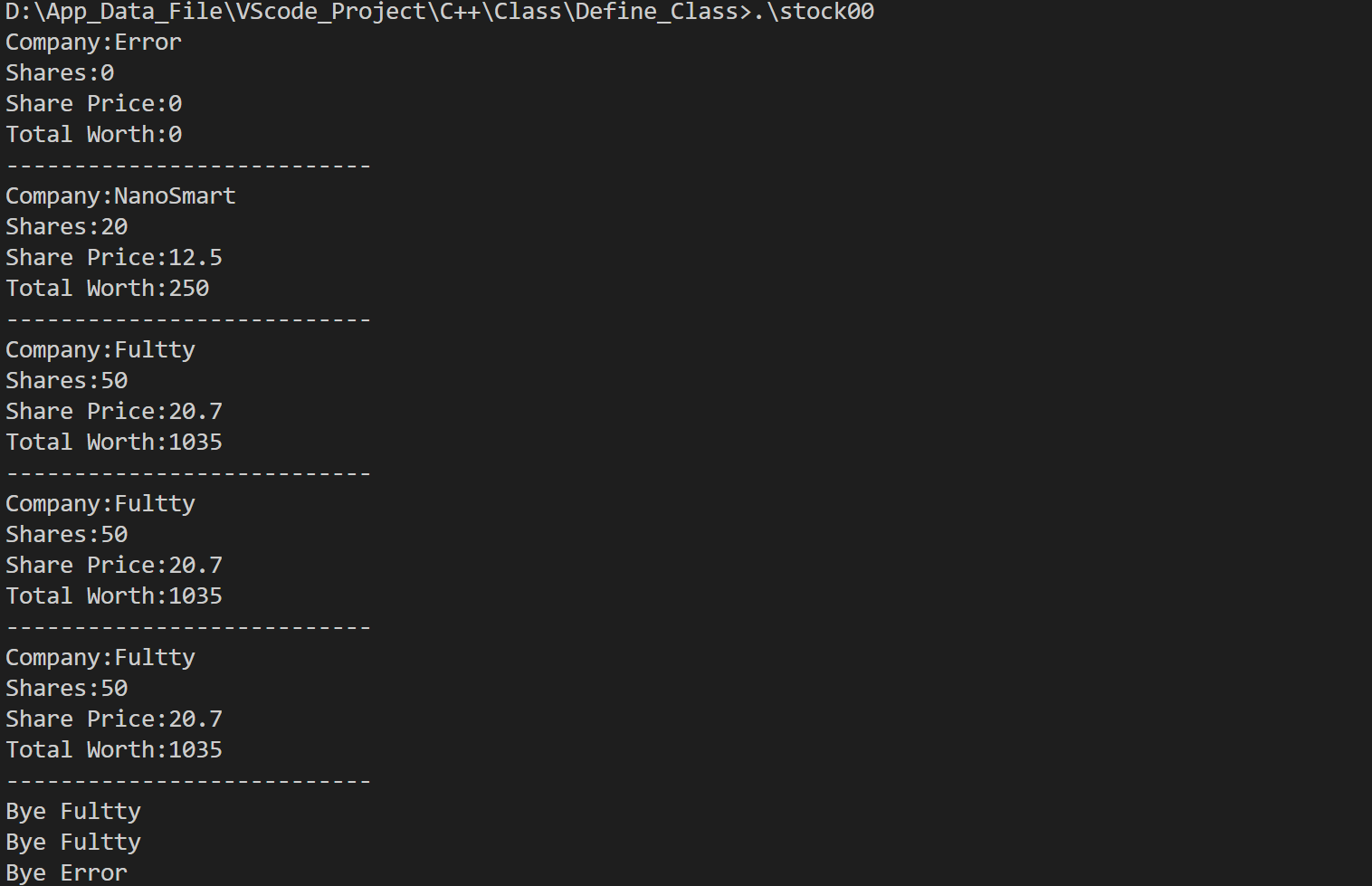
}结果如下:
5.const成员函数
- 在类方法后加上const,能保证类方法不修改调用对象
1 | public: |
1 | void Stock::show() const |
1 | int main(void) |
this指针
this指针指向调用成员函数的那个对象
this是对象的地址,*this才是对象本身
stock10.h
1
2
3
4
5
6
7
8
9
10
11
12
13
14
15
16
17
18
19
20
21
22
23
24
25
26
27
28
29
30
using namespace std;
//类的声明
class Stock
{
private:
string company;
long shares;
double share_val;
double total_val;
void set_tot(void){total_val=shares*share_val;}//其为内联函数,函数定义在类的声明中出现
public:
//默认构造函数定义方法1
//Stock(const string &co="Error",long n=0,double pr=0.0);
//默认构造函数定义方法2
Stock();
Stock(const string &co,long n,double pr);
//析构函数
~Stock();
const Stock & topval(const Stock &s) const;
void show() const;
};stock10.cpp
1
2
3
4
5
6
7
8
9
10
11
12
13
14
15
16
17
18
19
20
21
22
23
24
25
26
27
28
29
30
31
32
33
34
35
36
37
38
39
40
41
42
43
44
45
46
47
48
49
50
//类的定义
Stock::Stock()
{
company="Error";
shares=0;
share_val=0;
total_val=0;
}
Stock::Stock(const string &co,long n,double pr)
{
    company=co;//类的成员函数可以直接访问私有数据成员
    if(n<0)
    {
        cout<<"Number of shares can not be negative!"<<endl;
        cout<<"So set "<<company<<" shares =0"<<endl;
        shares=0;
    }
    else
    {
        shares=n;
    }

    share_val=pr;

    set_tot();
}
Stock::~Stock()
{
cout<<"Bye "<<company<<endl;
}
const Stock & Stock::topval(const Stock &s) const
{
if(s.total_val>total_val) //这里的total_val代表this->total_val
return s;
else
return *this;
}
void Stock::show() const
{
cout<<"Company:"<<company<<endl;
cout<<"Shares:"<<shares<<endl;
cout<<"Share Price:"<<share_val<<endl;
cout<<"Total Worth:"<<total_val<<endl;
cout<<"---------------------------"<<endl;
}main.cpp
1
2
3
4
5
6
7
8
9
10
11
12
13
14
15
16
17
18
19
using namespace std;
int main(void)
{
Stock sto("NanoSmart",20,12.5);
sto.show();
Stock csto("Huawei",89,12.3);
csto.show();
cout<<"The max is:"<<endl;
Stock top=sto.topval(csto);
top.show();
return 0;
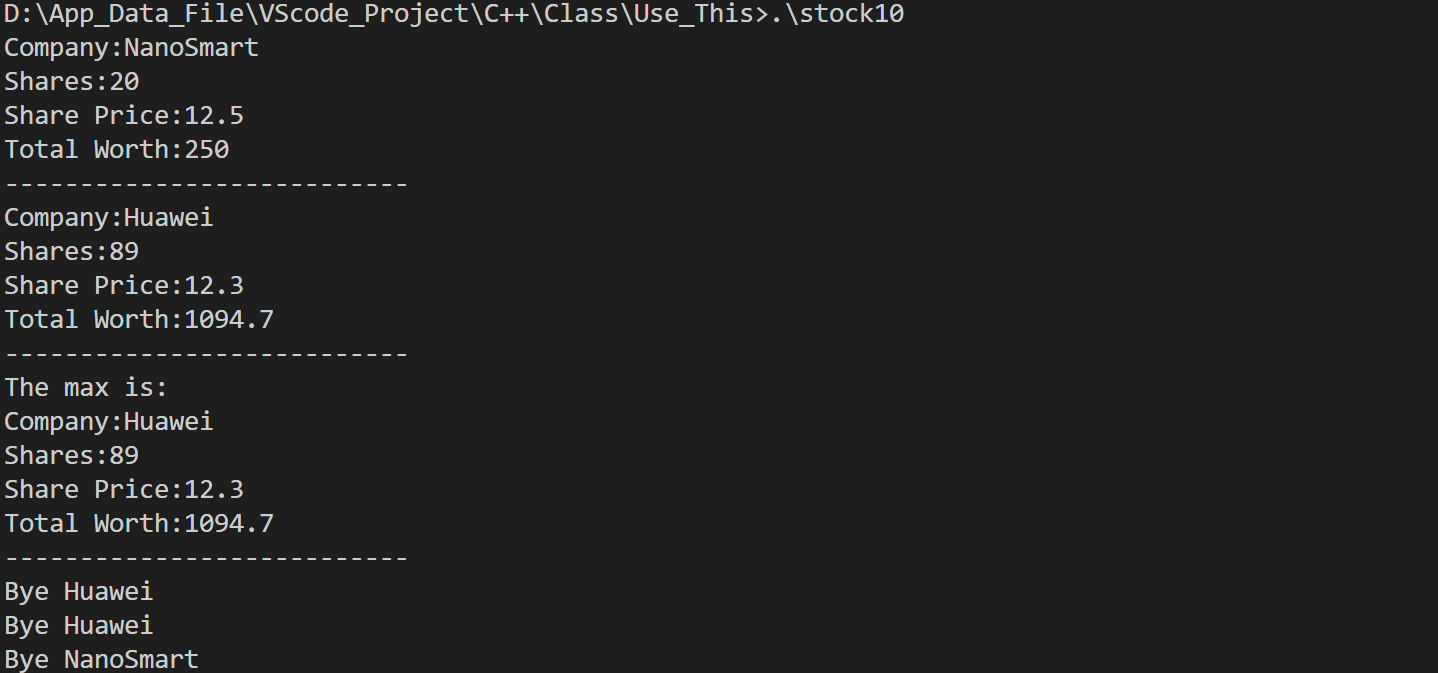
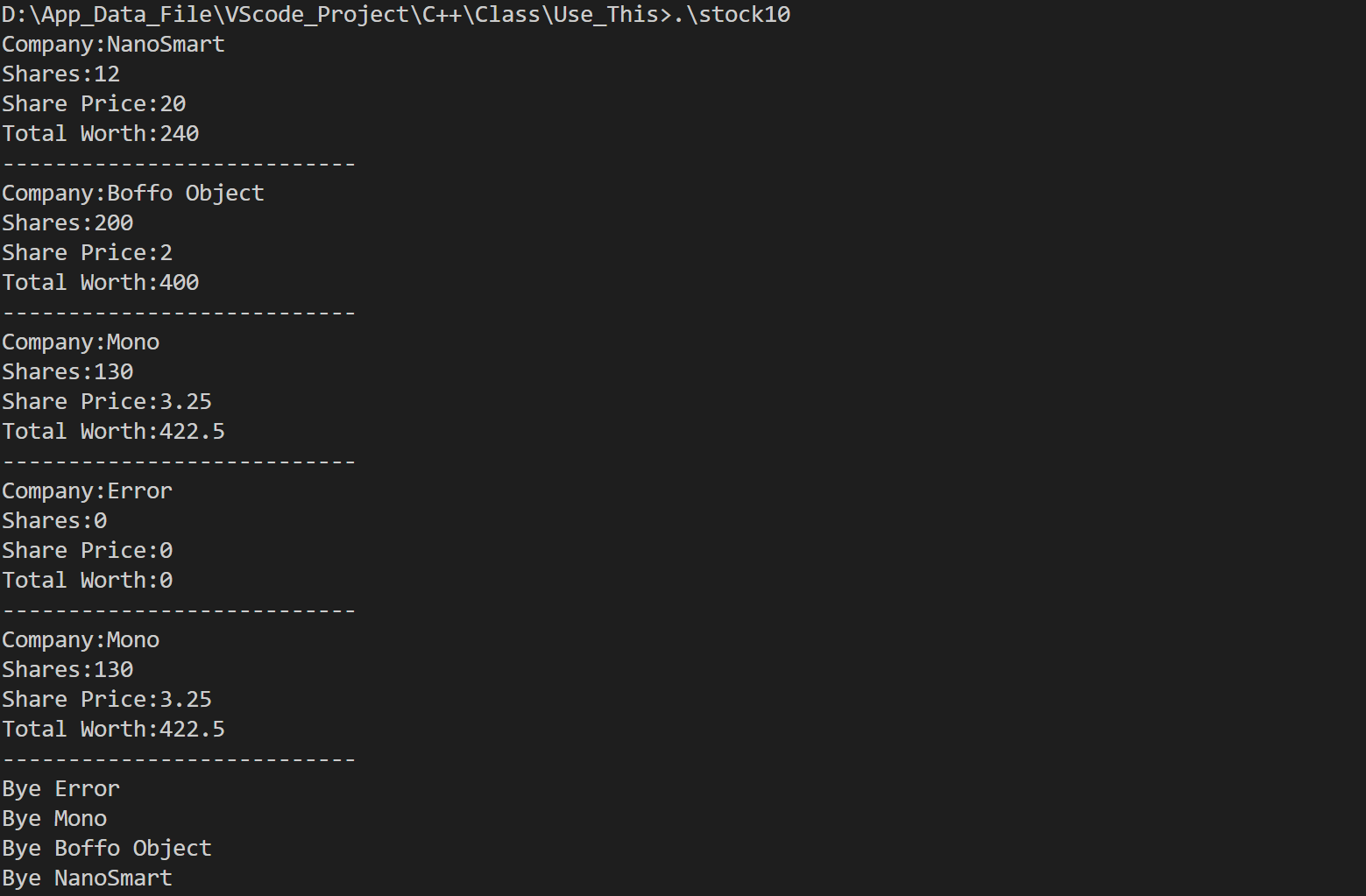
}结果如下:
对象数组
1 |
|
结果如下:
抽象数据类型
利用类实现栈操作
stack.h
1
2
3
4
5
6
7
8
9
10
11
12
13
14
15
16
17
18
19
20
21
22
23
typedef unsigned long Item;
class Stack
{
private:
//作用域为类的常量表示方法1:enum
enum {MAX = 10};
//作用域为类的常量表示方法2:利用static关键字
//static const int MAX=10;
Item items[MAX];
int top;
public:
Stack();
bool isempty() const;
bool isfull() const;
bool push(Item &item);
bool pop(Item &item);
};stack.cpp
1
2
3
4
5
6
7
8
9
10
11
12
13
14
15
16
17
18
19
20
21
22
23
24
25
26
27
28
29
30
31
32
33
34
35
36
37
38
Stack::Stack()
{
top = 0;
}
bool Stack::isempty() const
{
return top == 0;
}
bool Stack::isfull() const
{
return top == MAX;
}
bool Stack::push(Item &item)
{
if(top < MAX)
{
items[top++] = item;
return true;
}
else
return false;
}
bool Stack::pop(Item &item)
{
if(top > 0)
{
item = items[--top];
return true;
}
else
return false;
}stacker.cpp
1
2
3
4
5
6
7
8
9
10
11
12
13
14
15
16
17
18
19
20
21
22
23
24
25
26
27
28
29
30
31
32
33
34
35
36
37
38
39
40
41
42
43
44
45
46
47
48
49
50
using namespace std;
int main(void)
{
char ch;
unsigned long po;
Stack st;
cout << "Please etner A to push to stack, \n"
<< "P to pop from stack, Q to quit.\n";
while(cin >> ch && toupper(ch) != 'Q')
{
while(cin.get() != '\n')
continue;
switch(ch)
{
case 'A':
case 'a':
cout << "Enter a number you want to push to stack:\n";
cin >> po;
cout<<"----------------------------------"<<endl;
if(st.isfull())
cout << "Stack already full" << endl;
else
st.push(po);
break;
case 'P':
case 'p':
if(st.isempty())
cout << "Stack is empty" << endl;
else
{
st.pop(po);
cout << po << " is poped" << endl;
cout<<"----------------------------------"<<endl;
}
break;
}
cout << "Please enter A to push to stack, \n"
<< "P to pop from stack, Q to quit.\n";
}
return 0;
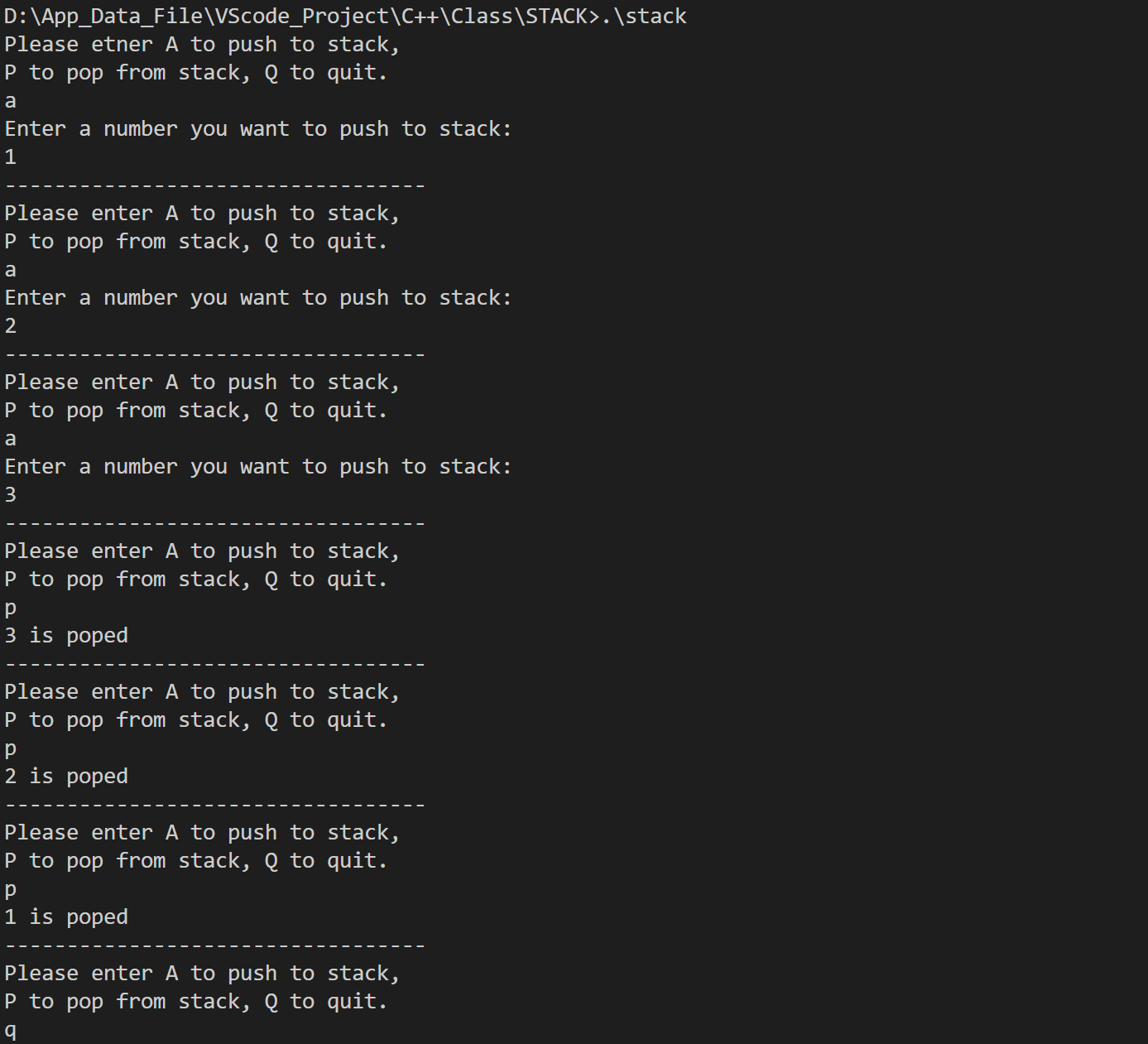
}结果如下:
实例:类实现简单列表
list.h
1
2
3
4
5
6
7
8
9
10
11
12
13
14
15
16
17
18
19
20
21
22
23
24
25
26
typedef unsigned long Item;
using namespace std;
void visit_item(Item &item);
class List
{
private:
enum {MAX = 10};
Item items[MAX];
int top;
public:
List();
bool isempty() const;
bool isfull() const;
bool add(Item &item);
void visit(void (*pf)(Item &));
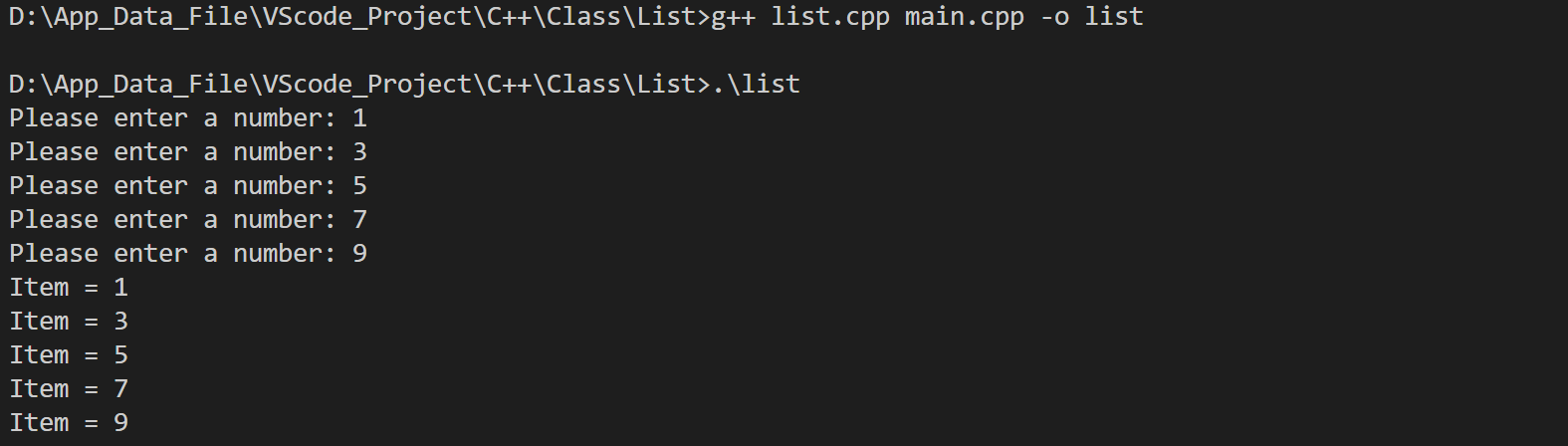
};list.cpp
1
2
3
4
5
6
7
8
9
10
11
12
13
14
15
16
17
18
19
20
21
22
23
24
25
26
27
28
29
30
31
32
33
34
35
36
37
38
List::List()
{
top = 0;
}
bool List::isempty() const
{
return top == 0;
}
bool List::isfull() const
{
return top == MAX;
}
bool List::add(Item &item)
{
if(top < MAX)
{
items[top++] = item;
return true;
}
else
return false;
}
void List::visit(void (*pf)(Item &))
{
for(int i = 0; i < top; i++)
pf(items[i]);
}
void visit_item(Item &item)
{
cout << "Item = " << item << endl;
}main.cpp
1
2
3
4
5
6
7
8
9
10
11
12
13
14
15
16
17
18
19
20
21
using namespace std;
int main(void)
{
List list;
Item num;
for(int i = 0; i < 5; i++)
{
cout << "Please enter a number: ";
cin >> num;
list.add(num);
}
list.visit(visit_item);
return 0;
}结果如下: